Tuesday, 10 January 2012

It's verb time!

What would happen if we didn't have verbs? Not much at all. Verbs are perhaps the most important part of speech in the English language. You can't do or be anything unless a verb lets you. Verbs are everywhere, and it's about time you got to know them with this list of verbs of many types.
Action verbs tell about something a person, animal, force of nature or thing can do or be. Can you cry, march, rinse, or turn? Can the wind blow or a cup fall? Yes, those are all actions. Use this list to think of other action verbs.
add
allow
bake
bang
call
chase
damage
drop
end
escape
fasten
fix
gather
grab
hang
hug
imagine
itch
jog
jump
kick
knit
land
lock
march
mix
name
notice
obey
open
pass
promise
question
reach
rinse
scatter
stay
talk
turn
untie
use
vanish
visit
walk
work
yawn
yell
zip
zoom

Verbs also use special rules for telling when something happened - in the past, the present, or the future. Here is a list of examples for each verb tense using the verb break. Try putting other verbs in the place of break.
Present tense – I/you/we/they break, he/she/it breaks
Past Tense – I/you/he/she/it/we/they broke
Future Tense - I/you/he/she/it/we/they will break
Present Perfect Tense – I/you/he/she/it/we/they have broken
Past Perfect Tense – I/you/he/she/it/we/they had broken
Future Perfect Tense – I/you/he/she/it/we/they will have broken

And now! It's the verb song time!


Don't worry. It is not that hard. We'll go deeper to understanding verb in the next entry. You are one step closer to become the next Grammar Guru!

It's the Pronoun Master!

Lets refresh our memory on pronoun


Lets listen to a video.


As you can see, Billy (noun) has been taken over by a pronoun I.

So let's see if you could understand by answering a few questions.


Please answer it in the comment box people :) Lots of love xx


Lets go deeper into "Pronoun"

Possessive pronouns show who owns something described in a sentence. They include mine, his, hers, its, ours, yours, their, and theirs. Possessive adjectives are similar to possessive pronouns. However, the possessive adjective comes before the object of the sentence; the possessive pronoun is the object of the sentence. See the difference here:

That is my dog. (possessive adjective, before the object “dog”)
The dog is mine. (possessive pronoun, which is the object)

Intensive pronouns and reflexive pronouns look the same. However, they act differently in a sentence. Intensive pronouns put an emphasis on other pronouns or nouns. Reflexive pronouns rename the subject in a sentence. Look at the following examples:

Intensive pronoun – She herself will go to the bank. (herself emphasizes the pronoun she)
Reflexive pronoun – She cut herself on the arm. (herself renames the pronoun she)

Intensive and reflexive pronouns include:
myself, yourself, himself, herself, itself, ourselves, yourselves, and themselves.
Demonstrative pronouns refer to things in relation to distance.
This and these refer to things that are close by. That and those refer to things farther away.

This is your shirt.
That is my house on the corner.
These good friends are sitting next to me.
Those roads in the next town are bumpy.

Indefinite pronouns replace nouns that are not specified. They include the following: all, another, any, anybody, anyone, anything, both, each, either, everybody, everyone, everything, few, many, neither, nobody, none, no one, nothing, one, several, some, somebody, someone, and something. Read the example sentences for a better understanding.

We gave everything to the homeless shelter
All were sad to see the children go.
Give a present to each as they come in.

Interrogative pronouns are used to ask a question. They include who, whom, what, which, whose, whoever, whomever, whatever, and whichever. Consider the example sentences below:

Which of these do you like best?
Who was just in this room?
Whatever happens next, I am prepared.

Relative pronouns connect (relate) noun or pronoun clauses with other parts of a sentence. They include who, whom, what, which, whose, whoever, whomever, whatever, whichever, and that. See how these are used in the sentences below.

The paper that she just wrote is due tomorrow.
Learning is easier for people who have a good teacher.
Whoever leaves the room needs to turn off the light.

Pronouns do a lot in the English language, don't they? They are the no-name workhorses, jumping in for thesuperstar nouns when they get exhausted. Hey, someone's got to do something about the work nobody wants to do!

Now that you have understand, we'll have a little exercise to see whether you have fun learning it in the next post :)

Friday, 6 January 2012

Let us learn on 'Pronoun'

Pronouns are the stunt doubles of the English language. They keep communication going with or without the nouns. Pronouns come in to keep nouns from getting repetitive or when nouns are not clearly known. They do more work than you think, so read on to learn about them.
Subject and object pronouns are used in everyday language. However, it can be tricky to remember which is which. The subject always takes action. The object is part of the activity, but it does not do any acting. Here is an example:
Shelby likes talking to Marvin.

Shelby is the subject; she is liking and talking. Marvin is the object; all the liking and talking is done to Marvin but not by Marvin.

Subject and object pronouns function in the same way.
Subject pronouns include I, you, he, she, it, they, we.
Object pronouns include me, you, him, her, it, us, them. See the following examples:

Subject
I might see you later.
You have to come now.
She lives in Nebraska.
He makes me angry
It just might work.
They caught the last train.
We can’t see the end.

Object
Sarah hit me on the arm.
I need to tell you something.
Larry took him aside.
The message wasn’t for her.
Take it to the store.
Summer is fun for us.
Margaret took them downstairs.

And now it's the time for the 'Pronoun' Song!!


Thursday, 5 January 2012

Introducing the 'Collective Nouns' people

Collective Nouns

Collective nouns refer to groups of people, animals, or things.
Examples:
audience, band, class, club, crowd, collection, committee
family, flock, group, herd, team

Example sentences:
Our class went to the museum today.

The audience clapped wildly at the end of the play.

I love my stamp collection!

class is made up of a group of students acting as one whole, anaudience is made up of a group of people acting as one whole, and acollection is made up of a group of things (in this case, stamps) acting as one whole.


Singular or Plural?

So, what do you think? Are they singular or plural? They name things that come together to act as one group.

If you said singular, you're right!

Even though each of these nouns is made up of many people, animals, or things, it names the group as a whole, which means that it is asingular noun.

You can make them plural the same way that you make other nouns plural. Usually, this means adding an s or es at the end of the word.

SingularPlural
classclasses
crowdcrowds
familyfamilies
flockflocks
For instance, schools are made up of more than one class of students. Because of this, we would say that there are multiple classes in a school.
Class is singular, and classes is plural.

So lets have a deeper view on nouns


Proper Nouns and Common Nouns

Proper

Proper nouns name specific people, places, things, or ideas.

Examples:
Siti, Najwa, Bangsar, Nike, Casio

Since these nouns are naming specific things, they always begin with a capital letter.
Sometimes, they contain two or more important words.

Examples:

Siti Nurhaliza, Mid Valley Mega Mall, Tutti Frutti
 
If this is the case, both important words are capitalized, and the whole thing is still considered to be one proper noun even though it's made up of more than one word. How about that?


Common

Common nouns are the opposite of proper nouns. They are your run of the mill, generic nouns. They name people, places, things or ideas that are not specific.


Examples:
woman, city, dog, shoe

Since these nouns are not naming anything specific, they do not need to start with a capital letter unless they begin a sentence.


Their Relationship


Every proper noun has a common noun equivalent, but not every common noun has a proper noun equivalent!


For example, dust is only a common noun. There is no specific kind of dust, so it's just common.

Monday, 2 January 2012

Nountastic time!

As promised, today we are going to have some nountastic time!
I believe yo guys have now have the basic knowledge about noun is it? We have sing a song about nouns yesterday so let's see whether you get the song!

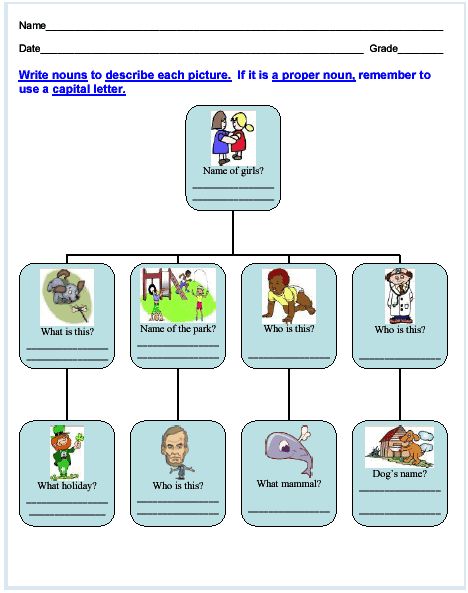
Lets describe the pictures!

Submit your answer to me, and I will get back to you later! :)